


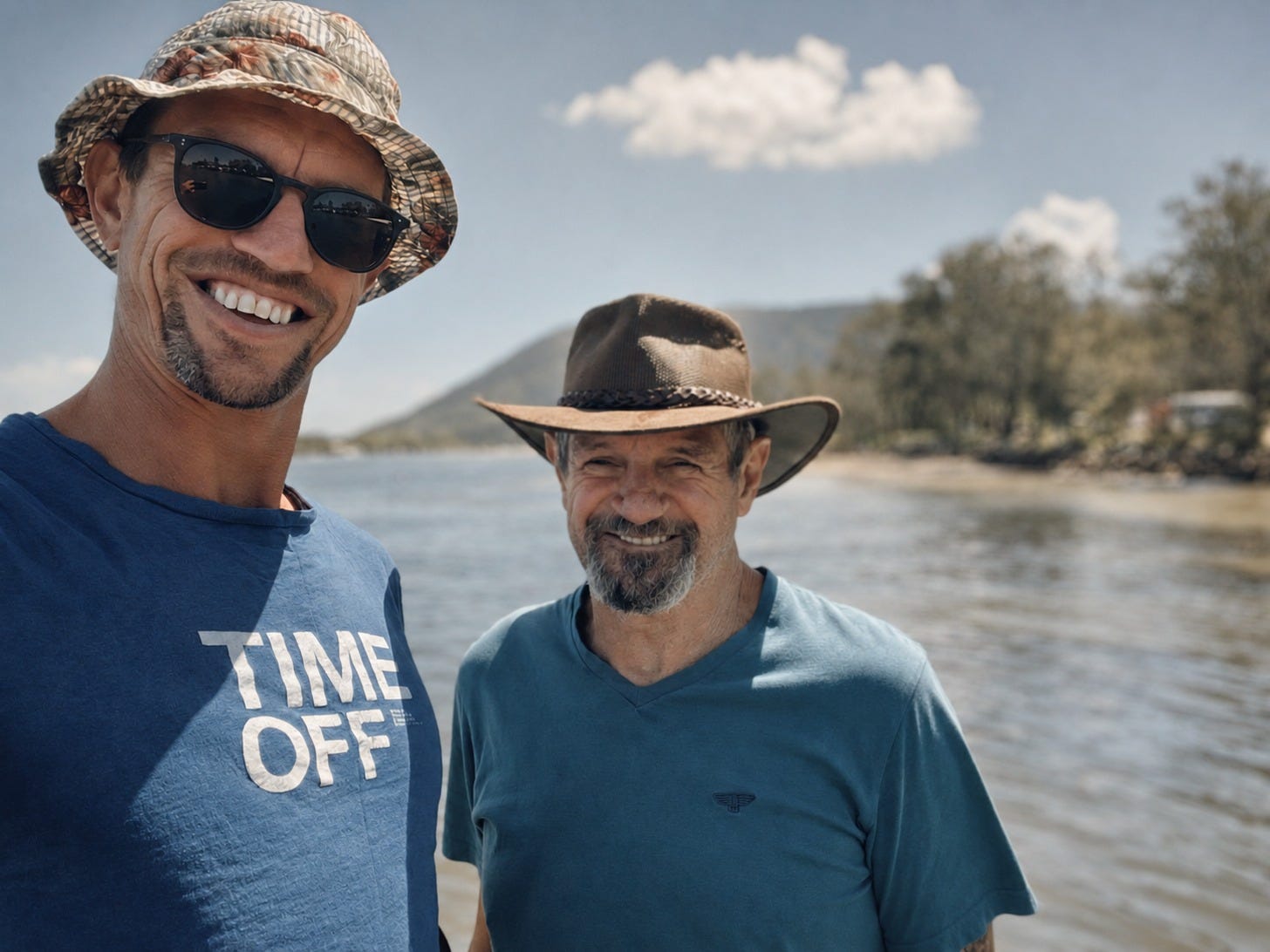
With Father’s Day today, I’ve been thinking less about what fathers tell us and more about what they quietly stay around to see.
This is about my dad. But it’s also about the people ahead of us, the people coming behind, and how long it can take to understand what we’ve been given.
The night before I left for Malaysia on August 1, we had a barbecue at my place for George. I’d known him since he was around thirteen. He was nineteen now and leaving for Columbia University in New York, something he had been working towards for a long time. It was a small celebration with many of the boys from the program, people who had been around him at different points. It was his farewell from our group.
My dad was there too. He was staying with me for a couple of weeks because I was flying out the next morning to Malaysia to train and spend some time around the Yoshinkan Aikido Gasshuku with Joe Sensei. (That story coming soon). Dad was going to stay at my place and look after our pup.
Eventually, after a beautiful evening together where George cooked us some amazing steaks for dinner and sat down and watched a farewell video we had put together, everyone left, and Dad and I started cleaning up. I don’t remember exactly what he said. I remember the way he looked at me when he said it. Dad has this way sometimes. He’s always been a pretty tough man, but every now and then something changes in him. You can see it in his face before he says much. That night he looked at me and told me how much he admired what I was doing. What I had built over the years with these boys. What he’d seen while he’d been staying with me.
It got me.
This is a man who watched me play AFL football for twelve or thirteen years. He loved his footy, and was enormously proud that his son played at that level, and I knew it. He followed everything. There were plenty of moments during those years when I knew how proud he was. But this felt different.
I think it meant more, and I feel slightly uncomfortable writing that because it makes it sound as though one kind of pride should outrank another. That’s not really it. Maybe it was because I was older and heard it differently. Maybe because he was older too. I don’t know. But I know where it landed.
There was nothing much to show him that night with George and the boys who span across many age groups. No jumper, no crowd, no club around me. No games tally or contract or anything that could be held up as proof. Just the mess left after a barbecue, a nineteen-year-old about to leave for College in America, and a group of boys who had been coming through my door for years. Maybe that was the proof.
It made me think a lot about when we first start believing in ourselves. It’s an odd thing to tell a young person to do. We say it all the time, believe in yourself as though a fourteen-year-old should know exactly what that means. Believe in what? At that age you barely know yourself. I certainly didn’t.
I wonder if belief starts in a much less impressive way. Before football gave me much evidence about myself, martial arts probably did. There were classes every week, and you turned up on a hard wooden floor. Discipline, structure, form. There was a way you stood and a way you behaved. There were expectations around respect and control that didn’t need to be explained every five minutes. They were just part of the place. The dojo
And there were gradings. Something ahead of you. You practised, got things wrong, practised some more and, eventually, you could do something you hadn’t been able to do before. I reached teaching rank third degree in my late teens as football started to shine for me. Nobody outside that world particularly cared. There wasn’t a crowd watching, and it wasn’t going to get my name in the paper. But I knew what it had taken to reach that grade.
Maybe that was my first real experience of belief. Not standing in front of a mirror convincing myself I was good enough. Just having evidence that if I stuck with something and trained hard, I could change and become better.
Then football came along and gave me evidence that was impossible to miss. Getting drafted into the AFL is a pretty powerful thing to happen to a young man. Someone chooses you. Here’s your jumper, locker and a contract. You’re part of this now. Then you play a game, and hopefully another one, and your name starts appearing next to things. Games played, goals, clubs and years. The world is giving you receipts.
I’m not dismissing that. Football gave me an enormous amount, and the hard work I put in made me in ways I’m probably still discovering. But I’ve started wondering whether there is a difference between having reasons to believe in yourself and becoming someone you believe in.
I think there is.
Professional sport gives you an incredible amount of structure. You don’t really appreciate how much until you’re out of it. Someone tells you when to arrive. Someone plans training. Someone selects the team. There are coaches, doctors, physios, strength staff, teammates. There’s a fixture and a ladder and, every weekend, a scoreboard. It’s all there.
Then it stops.
One of the traps after elite sport is that the evidence doesn’t disappear. Former AFL footballer. It’s a very convenient identity because nobody can argue with it. I did that, and I can always look back and borrow legitimacy from it.
But how long do you want to do that? At some point it feels a bit strange for a man in his forties or fifties to keep asking something he did in his twenties and early thirties to explain who he is now. I don’t mean that disrespectfully towards my football career. I’m proud of it. I don’t want to leave it behind. I just don’t want the best evidence for my life to be behind me.
That thought has bothered me for a while. So what have I made since?
That question is harder because nobody gives you the structure. The years after football haven’t followed any neat plan. I’ve followed things because something in them pulled at me. The art of movement, Martial arts again, breath, strength. The nervous system, play and stillness. Human development, really. Why one person stiffens under pressure, and another somehow stays loose. Why some environments seem to settle people and others do the opposite. What happens to a boy when someone expects something real from him?
I’ve had some great teachers and friends. I’ve travelled, read, trained, copied things and later realised I didn’t properly understand them. I changed my mind, threw things out, and came back to them years later. There wasn’t a master plan. I wish I could say there was, as it would make the story easier to tell.
Eventually, though, I started developing a real practice within myself. Then there was a room, a Dojo. Then boys started coming into it, and many of them kept coming. Their parents were a big part of that room too.
I realised Dad even helped build that room. Literally. We’ve been there until midnight laying flooring, fixing things, trying to get things to fit. Mostly Dad getting things to fit. He is a lot better with a spanner in his hands than I am, which becomes fairly obvious about thirty seconds into any job we do together.
I love doing that stuff with him. There is something good about being a grown man and still having those moments with your dad. You can have your own business, your own house, your own ideas about the world, and then you’re holding a tool incorrectly, and Dad is looking at you like, give me the bloody thing. And for a minute you’re just his son again.
Dad had a tough upbringing. By Year 8 he had been through thirteen schools.
Thirteen!
I still have trouble getting my head around that. He and his brother had to find their own way through a fair bit as young boys. There was a hardness to Dad that, when you know something about where he came from, makes sense. It was probably useful. Necessary even.
I don’t want to take his childhood and turn it into some tidy explanation for mine. That’s the sort of thing we do when we already know how a story turned out. Life was messier than that. Still, there’s something I can’t quite get past.
My father was a boy who went through thirteen schools by Year 8. Decades later, he was on his hands and knees helping his son put down the floor of a place where young people could keep coming back. Maybe that means something. I think it does. I’m just not sure I need to tell you exactly what.
George kept coming back. He arrived at around thirteen and was still there at nineteen. Six years is a long time in a young person’s life. People talk about youth development as though development is something we do to young people. I don’t really see it that way anymore. You can guide and challenge and teach, of course, but mostly I think you create the conditions and stay around long enough for something to happen. They have to want to stay too.
We’ve become obsessed with telling young people what they should become. Resilient, confident, disciplined, leaders, emotionally intelligent and respectful. We have language for all of it. Programs for all of it and sometimes many posters on walls.
I think we probably talk too much.
A boy doesn’t need another forty-five-minute explanation of responsibility. Give him something to be responsible for. Let him cook for his parents or peers. Let him help a younger boy. Ask him to set the room up as host. Better still, don’t ask him one day and see if he notices it needs doing. Let somebody depend on him a little. That changes things I feel.
A big part of what I’ve come to believe about boys is that they need people ahead of them. A father is enormously important. I know what my relationship with Dad has given me, and I see the importance of fathers through the families I work with. But not every boy has a father present. And even a very good father can’t, and probably shouldn’t, be everything.
Other people need to be further up the road. A grandfather. An uncle. A coach. A teacher. A Sensei. A family friend. An older boy. Someone worth watching.
I think watching matters more than we give it credit for. Adults are forever talking at young people. Sometimes I wonder whether what they need is fewer speeches and more adults worth observing.
Then, at some point, the relationship shifts. You’re still looking towards the people ahead of you, but now someone younger has started looking towards you.
I’ve watched this happen with the older boys. A sixteen- or seventeen-year-old realises a thirteen-year-old is paying attention to him. You can lecture the older boy on leadership if you want, but I’d rather give him a younger boy who trusts him. Now, how he behaves matters. Whether he turns up matters, and whether he notices the kid standing by himself matters. Whether he helps without needing credit for it matters. Whether his word means anything matters. Someone is watching.
I think we’ve lost some of this by organising young people almost entirely by age. Thirteen-year-olds with thirteen-year-olds. Fifteen-year-olds with fifteen-year-olds. Then adults stand at the front and tell all of them what they need to know. I’m not convinced that’s the best way people grow.
There should be someone ahead of you and, eventually, someone behind you. Maybe that’s part of becoming a man. Not some grand ceremony where everyone announces that it has happened. Just the moment, probably unnoticed, when you realise your behaviour is no longer only yours because someone younger has started taking their cues from you.
The funny thing is, I think this happened to me without me noticing either. Most of my life, I’ve looked ahead to coaches, teachers, sensei, mentors. People who knew something I didn’t. I still do it.
The morning after George’s barbecue, I got on a plane and flew to Malaysia to do exactly that again. I hadn’t really noticed the timing until later. One night I’m in my own place, a young man I’ve worked with since he was thirteen is about to leave for Columbia. My father is telling me he admires what I’ve built. The next morning I’m getting on a plane to go and train, listen, get corrected over and over and learn.
There’s something in that I like.
I used to think mastery meant getting closer and closer to the front of the room. Knowing more. Becoming the expert. Having fewer gaps. I’m not sure anymore.
There are things I know now. There are things I’ve spent decades practising, studying and thinking about, getting wrong, and I probably need to own that more than I have. Humility is important, but I think you can hide inside humility too. At some point, refusing to stand behind what you practice isn’t humility. It’s avoidance.
I’m still learning to step into my work more fully now.
But even that doesn’t feel like the end of it. The older I get, the less interested I am in building some fixed idea of who I am and then spending the rest of my life defending it. Football taught me how easily that can happen. Footballer. Former footballer. Coach. Teacher. Whatever comes next. They can all become another thing to hold onto.
Maybe the point isn’t to become more and more certain about who you are. Maybe it’s to need that certainty less.
To know what you know without having to make too much of it. To stand behind your work without turning yourself into the work. To teach when you’re the one with something to offer, then walk into someone else’s dojo the next morning and be completely comfortable knowing very little. There’s something freeing in that.
At eighteen, I probably needed to believe I could become someone. I needed the evidence. Now I’m less interested in becoming someone. I want to be fully in what I’m doing.
Maybe that’s closer to what I’ve been calling mastery.
Because mastery can’t mean being finished. Surely it’s almost the opposite. You should still be able to walk into somebody else’s dojo, bow, get corrected and realise the thing you thought you understood has another ten layers underneath it.
Someone ahead. Someone behind. Both at once.
There was another moment with Dad years ago that I’ve never forgotten. He was sitting at a table reading something I’d written. I was standing nearby. When he finished, he looked up at me and said, “Jesus, sometimes I wonder whether you’re my son or not.”
I honestly didn’t know how to take it. Was that good? Was he impressed by what I’d written, or was he thinking, " What the hell is this bloke talking about? I never asked him. For years I’ve had that little moment sitting somewhere in my head without knowing exactly what he meant.
I think about it differently now. Maybe one of the better things that can happen between a parent and a child is that eventually the child becomes someone the parent couldn’t have completely imagined. They should contain something of us, obviously. But they shouldn’t end with us.
They find teachers we never knew. They become interested in things we don’t understand. They make mistakes we couldn’t have prevented anyway. They travel somewhere we haven’t been. And if things go well, they take some of what we gave them and do something with it that is theirs.
There is probably more of Dad in my dojo than I’ve realised. Not necessarily in what I teach. More in how I think a place should work. Turn up, help and do something useful. Look after people, don’t walk past something that needs doing and if something is broken and you can fix it, fix it.
I think parenting changes as children get older. At first you have to direct so much of their lives. Eventually you can’t. Or you shouldn’t. Maybe the job then becomes less about directing the path and more about remaining interested while they make one for themselves.
Maybe that’s something worth remembering about fathers too. We tend to think their job is most important when children are young. True, but also not. The job changes. The distance changes. Sons and daughters build lives their fathers couldn’t have planned for them. But there can still be enormous power in a father remaining interested, staying close enough to notice, and every now and then saying what he sees.
I’m forty-eight. Dad is in his seventies.
Apparently you don’t completely grow out of wanting your dad to be proud of you.
Dad couldn’t have planned what I’m doing now. I couldn’t have planned it either. He doesn’t need to understand every part of what I’m studying or why I’ve followed one thing into another. He’s remained interested in me. There’s a difference.
And I wonder if that’s part of what we owe the young people coming behind us too. Not to map the whole road for them. Not to keep shouting directions but to stay close enough to notice where they’re going.
That night Dad had been watching. Not just the barbecue. He’d been staying at my place and had seen boys coming and going. All of them stopped and talked to him. He’d seen the rhythm of the place. Then he watched George leave for his dream.
I think that’s why his words got to me. He wasn’t congratulating me for something I’d achieved. He was looking at something that had grown.
Football gave me some of the first serious evidence that I could do difficult things. Martial arts probably gave me some before that. I needed both. Maybe we all need that sort of proof when we’re young. A belt, a selection, a football jumper and someone choosing you.
But I think belief changes as you get older. When you’re young, you probably need some proof. Something that tells you: you can do this. Later, the work is different. You have to start choosing yourself. Stand behind what you’ve learned; take responsibility for what you can offer. Maybe even stop waiting for another institution to tell you that you’re allowed to do it.
For years I probably thought believing in yourself meant becoming more certain about who you were. Maybe I need to know myself well enough to stop thinking about myself quite so much.
There is work in front of me. People I care about. Things I can offer. Things I still don’t understand. And once someone starts coming behind you, some of that belief isn’t only about you anymore. Sometimes you have to hold a little for them until they’ve got enough evidence to hold it themselves.
Not by telling them how special they are. Give them something real to do. Expect something of them. Stay around and notice them. Let them get things wrong. And eventually, let them leave.
The morning after the barbecue, George was preparing for America. I went to Malaysia. Dad stayed at my house and looked after the pup. It’s all pretty ordinary when I write it down.
I think that’s why it means something to me.
Dad had helped me put down the floor. Boys had grown up on it. One of them was leaving. I was heading somewhere else to learn. Dad was still helping.
There is someone ahead. There is someone behind. I don’t think we ever graduate from either.
That night, after everyone had left, Dad and I cleaned up. He looked at me in that way he sometimes does and told me what he thought about what I was doing.
No crowd heard it. There was nothing to win. Just Dad and me, cleaning up after a boy’s farewell.
It was enough.